
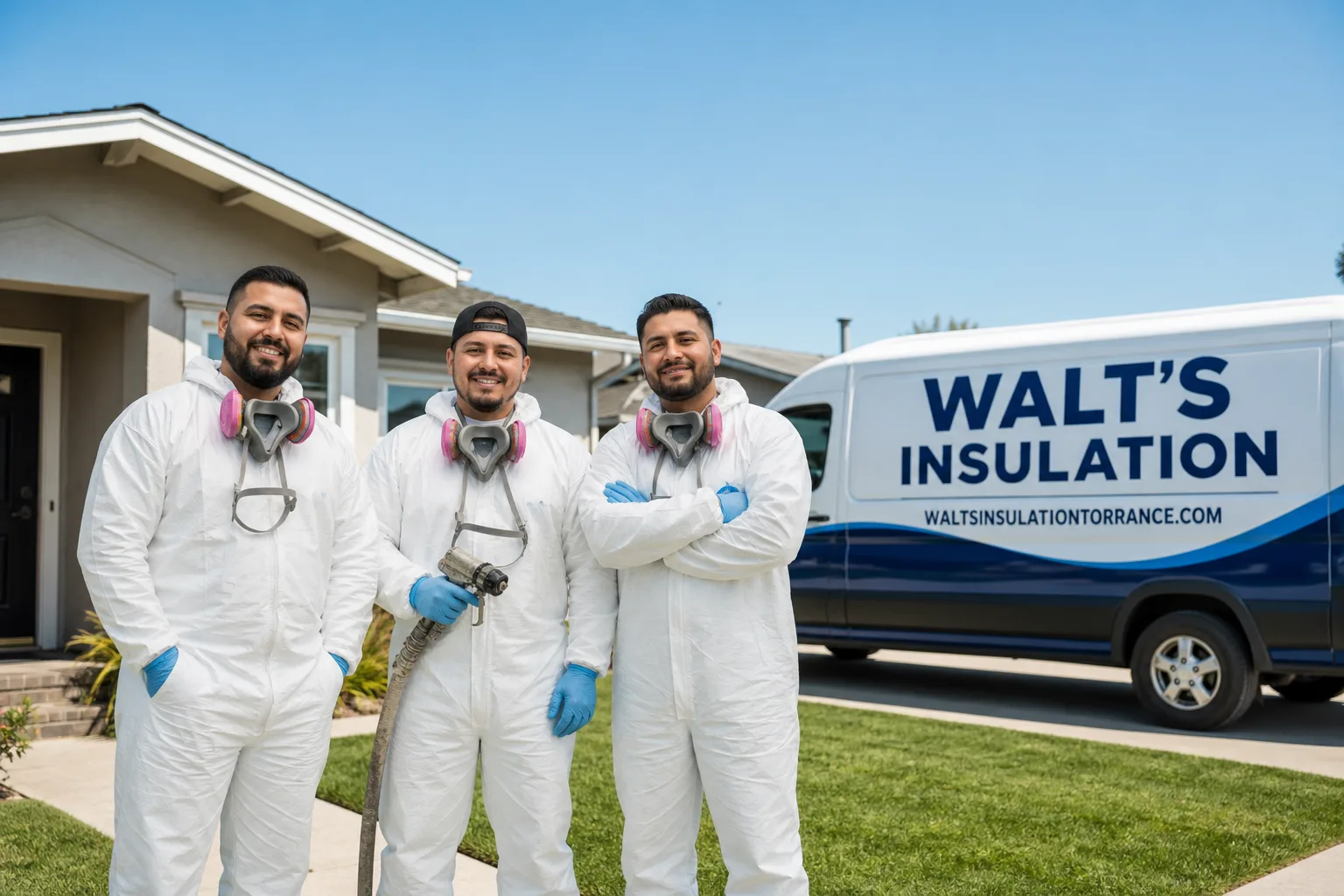
How Much Does Spray Foam Insulation Cost in Torrance?
Our Spray Foam Insulation services in Torrance, CA typically cost between $1,800 and $6,500 for a whole-home or attic project, with most homeowners landing somewhere around $2,800 to $4,200 depending on square footage and foam type. Open-cell foam runs roughly $0.44 to $0.65 per board foot, while closed-cell foam runs $1.00 to $1.50 per board foot – both figures reflect current South Bay labor and material rates. Most jobs in Torrance are completed in a single day, and you can get a free, no-obligation estimate by calling (424) 955-2557.
Spray Foam Insulation Cost Breakdown (2026)
The table below reflects real pricing we see in the Torrance market. Costs will shift based on access difficulty, existing insulation removal needs, and which foam product is the right fit for your home – but these ranges give you a solid benchmark before anyone sets foot in your attic.
| Application / Area | Foam Type | Typical Cost Range (Torrance, 2026) |
|---|---|---|
| Attic (1,000 sq ft) | Open-Cell | $900 – $1,600 |
| Attic (1,000 sq ft) | Closed-Cell | $2,000 – $3,200 |
| Crawl Space Encapsulation + Foam | Closed-Cell | $1,800 – $3,800 |
| Rim Joists (full perimeter) | Closed-Cell | $400 – $900 |
| Garage Ceiling (400-600 sq ft) | Open-Cell or Closed-Cell | $600 – $1,400 |
| Wall Cavities (new construction or retrofit) | Open-Cell | $1,200 – $2,800 |
| Whole-Home Air Sealing + Foam (existing home) | Mixed | $2,800 – $6,500 |
| Small Targeted Sealing (crawl vents, penetrations) | Closed-Cell | $300 – $700 |
A couple of things worth understanding about how these numbers work. Board feet – not square feet – is the unit spray foam contractors actually price by. One board foot equals one square foot of coverage at one inch of thickness. If your attic needs 3 inches of open-cell foam across 1,000 square feet, that’s 3,000 board feet. At $0.55 per board foot, that’s $1,650 in material and labor combined. Closed-cell foam requires fewer inches to hit the same R-value, so the per-board-foot cost is higher but you use less of it – the math is closer than it looks.
Labor typically makes up 40 to 50 percent of the total bill in Torrance. South Bay labor rates run a bit higher than the Inland Empire, which is normal for coastal Los Angeles County. When you get a quote, make sure it breaks out material cost, labor, and any prep work like old insulation removal separately – that’s how you actually compare bids.
What Affects Spray Foam Insulation Pricing in Torrance
- Foam type: open-cell vs. closed-cell. Open-cell foam is softer, expands more, and costs less per board foot – around $0.44 to $0.65. It works well in attics and interior walls where moisture intrusion isn’t the primary concern. Closed-cell foam is denser, acts as a vapor barrier, and is the right call for crawl spaces, rim joists, and exterior-facing applications in Torrance homes that sit closer to the coast where marine layer moisture is a real factor. It costs more but delivers a higher R-value per inch (around R-6.5 to R-7 per inch versus R-3.5 to R-4 for open-cell).
- Square footage and thickness required. Bigger homes cost more – that part’s obvious. What’s less obvious is that the required thickness drives cost just as much. California Title 24 energy code sets minimum R-value requirements that affect how many inches of foam you need. In Torrance, attic insulation must meet R-38 minimum under current code. Hitting R-38 with open-cell foam takes about 10 inches; with closed-cell, you’re closer to 6 inches. That thickness difference changes the board-foot count significantly.
- Existing insulation removal. Many Torrance homes built in the 1950s and 1960s – particularly in the neighborhoods around Southwood and Old Torrance – have original fiberglass batts or blown-in insulation that needs to come out before spray foam goes in. Removal typically adds $500 to $1,500 to the total, depending on what’s there and how accessible the space is.
- Access and attic conditions. Low-pitch rooflines and cramped attic clearances are common in Torrance’s post-war ranch homes. Tight spaces take longer and require more care from the technician, which translates to higher labor cost. If your attic has less than 24 inches of clearance or has unusual framing, expect quotes toward the higher end of any range.
- Torrance’s marine climate and moisture management. Homes west of Hawthorne Boulevard – particularly in the Hollywood Riviera and Walteria neighborhoods – deal with persistent marine layer and coastal humidity. Closed-cell foam is often the right choice in these areas because it resists moisture vapor migration, which can cause mold in poorly sealed attic spaces. Choosing the wrong foam type to save money upfront can cost more in remediation down the road.
- Permit requirements. Most spray foam jobs in Torrance do not require a building permit as long as the work is limited to air sealing or insulation within existing framing. However, if the project involves structural changes or is part of a larger remodel, the Torrance Building and Safety Division may require a permit. We always advise clients to confirm with the city before work begins – any contractor who discourages you from pulling permits is a red flag.
Open-Cell vs. Closed-Cell: Which One Does Your Torrance Home Actually Need?
This is the question we get on almost every estimate call, and the honest answer is: it depends on where the foam is going, not which one sounds better in a brochure.
For attic rafters and interior wall cavities in Torrance homes, open-cell foam from manufacturers like Icynene or Demilec is a solid choice. It fills irregular cavities well, provides good sound dampening (useful if you’re near Hawthorne Municipal Airport flight paths), and costs less. The trade-off is lower R-value per inch and zero vapor resistance – so it’s not the right pick for a crawl space or any area that sees liquid moisture.
Closed-cell foam is the better call for crawl spaces, rim joists, basement walls (less common in Torrance but present in some hillside properties), and exterior-facing surfaces. It’s also the standard choice for garage ceilings where you want the R-value but don’t have inches to spare. Closed-cell products from manufacturers like Johns Manville or Demilec deliver around R-6.5 to R-7 per inch, which means you can hit California’s minimum requirements in a shallower depth.
Some projects use both – open-cell in the attic field and closed-cell on rim joists and penetrations. We’ll walk you through exactly which product makes sense for each area of your home during the free estimate, so there’s no guessing.
California Energy Code and Torrance Permits: What You Need to Know
California’s Title 24 energy standards set minimum insulation requirements that affect how much foam you need – and therefore what you’ll pay. For Torrance, which falls in California Climate Zone 9, the minimum attic insulation requirement is R-38 for existing homes undergoing improvement and R-49 for new construction.
If you’re applying for utility rebates through Southern California Edison or SoCalGas, you’ll need to meet or exceed Title 24 minimums and document the installation with proper receipts and product data sheets. We handle that paperwork as part of the job – it’s not an add-on.
On the permit side: standalone insulation installation in an existing home generally doesn’t require a permit in Torrance. If the spray foam is part of a larger permitted project – say, a room addition or full HVAC replacement – it gets pulled under the main permit. When in doubt, a quick call to the Torrance Building and Safety Division at City Hall on Torrance Boulevard will give you a definitive answer for your specific project.
What Southern California Edison and SoCalGas Rebates Are Available?
Torrance homeowners can access rebate programs through Southern California Edison’s Energy Upgrade California program and SoCalGas’s rebate portal. As of 2026, rebates for insulation upgrades are typically tied to meeting specific R-value improvements and may range from $100 to $500 or more depending on square footage and the efficiency upgrade documented.
The federal Inflation Reduction Act’s 25C tax credit also applies to spray foam insulation installed in existing homes – as of 2026, eligible homeowners can claim 30 percent of the cost, up to $1,200 per year, for insulation and air sealing improvements. That’s a meaningful offset on a $3,000 to $4,000 spray foam job. We always recommend confirming current credit limits with a tax professional since these figures can change, but the credit has been stable through the programs we’ve seen homeowners use.
The point is: the sticker price on spray foam is rarely the final price after rebates and credits. Factor that in when you’re comparing spray foam to cheaper alternatives like blown-in fiberglass.
How to Save on Spray Foam Insulation in Torrance
There are real ways to reduce your cost without cutting corners on the job itself. Here’s what actually moves the needle:
- Get a free second opinion on any written estimate. We offer this as a standing policy – bring us a written quote from another contractor and we’ll review it at no charge. Sometimes the competing bid has the right price but the wrong foam type for the application. Sometimes the scope is missing something that’ll cost you later. Either way, you should know what you’re buying before you sign.
- Ask about combining attic air sealing with foam installation. Doing both in the same visit saves setup time and equipment costs. Attic air sealing – closing gaps around recessed lights, plumbing penetrations, and top plates – typically runs $300 to $700 as a standalone service. Bundled with a foam job, that same work often costs less because the equipment is already staged.
- Apply utility rebates before signing. Contact SCE or SoCalGas ahead of the job to understand what documentation they require. Some rebates require a pre-inspection. Don’t miss that step or you’ll lose the rebate eligibility.
- Use the 25C federal tax credit. As described above, 30 percent back on up to $1,200 in insulation and air sealing costs is real money. Keep your invoice and the product data sheet from whatever foam product was installed – your tax preparer will need both.
- Seniors and veterans get 10% off every job, always. No expiration, no minimum. This is a permanent discount at Walt’s Insulation – not a seasonal promotion. If you or anyone in your household qualifies, mention it when you call.
- Schedule during slower months. Insulation demand in Torrance tends to peak in late spring and again in September as homeowners prep for the warmer stretch. If your timing is flexible, late January through March is typically easier to schedule and you’re more likely to get a crew that isn’t stretched thin.
- Don’t over-spec the job. Closed-cell foam costs roughly twice as much as open-cell per board foot. Using closed-cell in places where open-cell would perform equally well is a common way contractors run up bills. A good installer will match the product to the application – not default to the more expensive option across the board.
For a free estimate with upfront pricing – no vague ranges, no surprises on install day – call us at (424) 955-2557. There’s no trip charge inside Los Angeles County and a live person answers every call.
Why Spray Foam Costs More Than Batts or Blown-In (and When It’s Worth It)
Fiberglass batts cost $0.10 to $0.25 per square foot. Blown-in cellulose or fiberglass runs $0.80 to $1.50 per square foot installed. Spray foam, as you’ve seen, runs considerably higher. So why do thousands of Torrance homeowners choose it anyway?
The short answer: spray foam is the only insulation type that seals and insulates at the same time. Traditional insulation slows heat transfer. It doesn’t stop air movement. And in a typical Torrance home with gaps around recessed lights, plumbing penetrations, and framing joints, air leakage accounts for 25 to 40 percent of heating and cooling loss. Blown-in fiberglass doesn’t fix that. Spray foam does.
The practical payoff shows up on Edison bills. Homes with properly air-sealed attics and spray foam typically see 15 to 25 percent reductions in HVAC energy use – sometimes more in homes that previously had no attic insulation or badly degraded batting. In a South Bay climate where air conditioning runs four to six months a year, that adds up.
Spray foam also outlasts other insulation types. It doesn’t settle, it doesn’t absorb moisture and compress over time, and it doesn’t become a habitat for rodents the way loose-fill insulation sometimes does in Torrance homes with pest history. The lifetime workmanship we stand behind under our Done Right Promise means you’re not looking at a re-do in ten years.
That said, spray foam is not always the right call. If your attic is already well air-sealed and just needs an R-value upgrade, blown-in insulation – we install GreenFiber, Owens Corning, and Knauf products – might be the more cost-effective choice. We’ll tell you that during the estimate if it’s the case. Our goal is to sell you the job that’s right for your home, not the most expensive option on the menu.
Torrance-Specific Considerations: What We See on Jobs Here
We’ve been doing insulation work in Torrance since 2000, and certain patterns show up again and again on local jobs.
Homes in the Hollywood Riviera, Walteria, and the streets near Del Amo Fashion Center tend to have original fiberglass batts that have been in place since the home was built – often 1955 to 1975. That insulation is typically compressed, dirty, and nowhere near current R-value standards. It almost always needs to come out before foam goes in, and we factor that into the estimate rather than quoting just the foam and leaving the removal cost for a surprise.
In the South Torrance neighborhoods closer to the 110 and 405, we see a lot of homes with crawl spaces rather than slab foundations. These crawl spaces are frequently under-insulated or completely uninsulated, and in some cases they’re damp from ground moisture migration. Closed-cell spray foam on the crawl space walls and header joists – combined with a proper vapor barrier on the ground – is the fix we install most often in those areas. It typically runs $1,800 to $3,800 depending on crawl space square footage and access.
Homes near Torrance Beach and the Seaside neighborhoods deal with salt air and persistent marine layer humidity. That combination accelerates the degradation of fiberglass insulation and makes the vapor resistance of closed-cell foam particularly valuable. It’s not something every insulation contractor emphasizes, but after 25 years of working in coastal LA County, we’ve seen what happens to poorly specified insulation in these micro-climates.
If you want a full picture of our spray foam work in the area, the Spray Foam Insulation in Torrance page covers the full scope of what we install and why – materials, process, and what to expect on job day.
FAQs – Spray Foam Insulation Cost in Torrance
How much does spray foam insulation cost per square foot in Torrance, CA?
Spray foam insulation in Torrance costs roughly $1.00 to $2.50 per square foot of coverage, depending on foam type and required thickness. Open-cell foam is typically on the lower end of that range; closed-cell foam with the thickness needed to meet California Title 24 minimums runs toward the higher end. Those figures include both material and labor. For an exact number on your specific attic or crawl space, call (424) 955-2557 – estimates are free and we don’t charge a trip fee in Los Angeles County.
Is spray foam worth the cost compared to blown-in insulation in Torrance?
For most Torrance homes with significant air leakage – which includes the majority of homes built before 1990 – spray foam typically delivers faster payback because it handles both insulation and air sealing in one step. Blown-in insulation costs less upfront but doesn’t stop air movement through gaps and penetrations. If your home is already well air-sealed and just needs R-value, blown-in can be the smarter spend. We’ll give you an honest comparison during the estimate rather than defaulting to the more expensive option.
How long does spray foam insulation last in a Torrance home?
Properly installed spray foam – whether open-cell or closed-cell – doesn’t degrade, settle, or compress over time. Most manufacturers, including Icynene and Demilec products we use, rate their spray foam for the life of the structure. We back every installation with the Done Right Promise, which is a lifetime workmanship guarantee. If something isn’t right with how it was applied, we come back and fix it – no runaround.
Can I get spray foam insulation installed the same day I call in Torrance?
Same-day installation isn’t typical because spray foam jobs require proper equipment setup and prep time, but we can usually schedule within a few business days for most Torrance locations. In slower periods – typically January through March – turnaround is often faster. If you have a situation that’s genuinely urgent, call (424) 955-2557 and talk to someone directly. A live person answers every call, around the clock, and we’ll tell you honestly what the earliest available slot looks like.
Does spray foam insulation require a permit in Torrance?
Standalone spray foam insulation installation in an existing Torrance home generally does not require a building permit. If the work is part of a larger permitted project – a remodel, addition, or HVAC replacement – it gets covered under that permit. We always advise homeowners to confirm with the Torrance Building and Safety Division for their specific project before work begins. Any contractor who tells you permits are never required without knowing your project scope is giving you incomplete information.
What rebates are available for spray foam insulation in Torrance in 2026?
Torrance homeowners may qualify for rebates through Southern California Edison and SoCalGas under energy efficiency programs tied to California’s Energy Upgrade California initiative. Rebate amounts vary by program cycle and project scope but have historically ranged from $100 to $500 or more for qualifying insulation upgrades. Separately, the federal 25C tax credit allows eligible homeowners to claim 30 percent of insulation and air sealing costs, up to $1,200 per year. We provide the documentation you’ll need for both – confirm current rebate availability with SCE or SoCalGas directly before scheduling, as program funding can change.
Key Takeaways
- Spray foam insulation in Torrance typically costs $1,800 to $6,500 for whole-home or attic projects, with most jobs landing around $2,800 to $4,200.
- Open-cell foam runs $0.44 to $0.65 per board foot; closed-cell runs $1.00 to $1.50 per board foot.
- Torrance’s coastal climate and older housing stock – particularly in Hollywood Riviera, Walteria, and South Torrance – often favor closed-cell foam for moisture resistance.
- California Title 24 requires R-38 minimum for attic insulation in Torrance (Climate Zone 9) for existing homes under improvement.
- Federal 25C tax credit covers 30% of eligible costs up to $1,200 per year; SCE and SoCalGas rebates may apply as well.
- Seniors and veterans get a permanent 10% discount at Walt’s Insulation – no expiration date.
- Free estimates, no trip charge in LA County, and a lifetime Done Right Promise on every job.
Get a Free Spray Foam Estimate in Torrance
Walt Brenner and the team at Walt’s Insulation have been doing this work in Torrance and across the South Bay since 2000. We’re locally owned, not a franchise, and our number goes to a real person every time you call – not a voicemail, not an answering service. If you’ve already got a written quote from another contractor, we’ll give you a free second opinion on it. If you’re starting from scratch, we’ll come out, assess what your home actually needs, and give you straight upfront pricing before any work begins.
From the home page you can see the full range of services we cover – from attic air sealing to crawl space encapsulation to insulation removal and replacement. Whatever’s going on with your home’s thermal envelope, we can look at the whole picture rather than just the one service you called about.
Call (424) 955-2557 to schedule a free estimate. We’re the one down the road – and we’ll still be here after the job is done.
Pricing reflects the Torrance market as of 2026. Walt’s Insulation offers free estimates – call (424) 955-2557.
Written by Walt Brenner, Owner at Walt’s Insulation, serving Torrance since 2000.
What Our Customers Say
"Radiant barrier and new insulation in one visit. Walt explained what the foil actually does and what it does not, which nobody else bothered to. Electric bill in July was the lowest it has been in this house."
- Nadia Haddad"We had the walls of our old house filled with foam through small holes from the outside. Patched and painted the same afternoon. The bedrooms hold heat now and the furnace runs a lot less."
- Linda Baumgartner"Air sealing first, then blown-in over the top. He found a bathroom fan venting straight into the attic and fixed that too. Written price before they started, same price when they finished."
- Arjun Mehta